A few years ago our family of four went to an adventure resort in the Mexican Riveria. It’s often billed as the “Disney World of Mexico” and I can see why. Your stay includes all-access passes to 7 adventure parks where you can snorkel, ride amphibious vehicles through the jungle, zipline through treetops at night, waterslide into the Caribbean, and the list goes on. It does not exactly spell R-E-S-T but it certainly was a blast. One of our favorite experiences was going through what was called the Sensatorium. Families lined up to wait their turn to enter what looked like a charming adobe house from the outside, but once you stepped inside you found yourself in utter darkness. I’m talking can’t see your hand in front of your face. Your mission, should you choose to accept it, is to “feel” or “sense” your way through various artificial landscapes until you found the exit. Many families in front of us did not make it and ended up coming back out the way they come, faces white as a ghost. Naturally my family saw this as incentive to make it all the way through, even though internally we were pretty terrified. We had to go one at a time, and as I gingerly felt my through a pitch black makeshift Mexican hacienda I could hear myself saying “I can’t do this. I can’t do this.” But, alas, I did—we all did, in fact— and it was pretty amazing. It took us each about 40 minutes to get through and we came out the other side with eyes wide and smiles broad. As I look back on that experience it strikes me that I did it while saying on repeat that I couldn’t.
A group of dear friends and I are studying the Beatitudes. In the sermon on the mount in Matthew chapter 5, Jesus offers up a radical reversal of values, beginning with the beatitudes. A few wise commentators suggest that you can see the beatitudes as rungs on a ladder, and the reason the first one says “Blessed are the poor in spirit” is because it is the necessary and universal experience that precedes all the others. As we studied this verse, we began to realize that if it had a banner hanging over it, the banner might read in big, fat, unmistakable letters “I CAN’T.” If being middle class in spirit says, “Sure, I need Jesus, but I can also manage a lot of life on my own,” then being poor in spirit says “I can’t do one thing on my own. Life is bigger than my ability to pull it off and I need someone stronger and wiser than me to even get me up off the floor.” The posture of I CAN’T is the beginning of the Gospel. It is the beginning of good news.
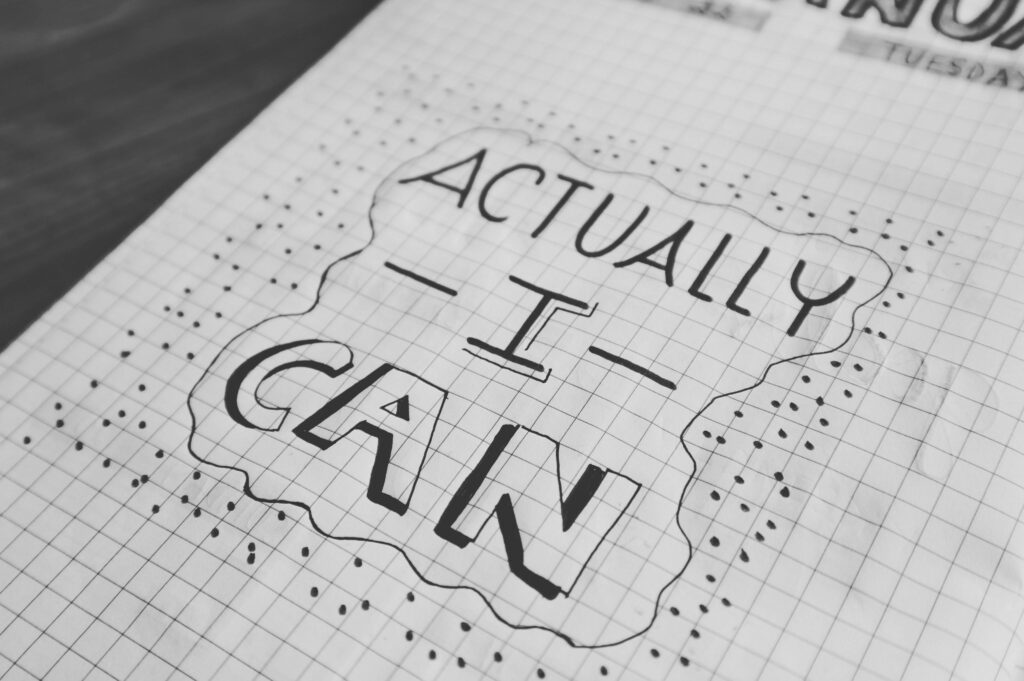
As a group we stacked hands practicing our “I can’t” statements throughout the week, working to trust that when we embrace our poor spirits Jesus will set us free. We got into the weeds with statements like “I can’t make my daughter be less moody,” “I can’t stop the roof from leaking,” “I can’t make my husband understand me more,” “I can’t stop overthinking things,” and the list went on. We each found a quiet rest beginning to emerge as we stopped fighting our own limitations. And as I practiced my “I can’t” statements I drilled down until I stumbled upon the biggest one of all – I can’t stop thinking that I can’t. I laughed as I heard these words come out of my mouth and sensed Jesus laughing with me as we took an honest and shameless look at my own heart.
And while this statement might feel discouraging at first glance, there’s something else important to note about the beatitudes. When Jesus offers up radical reversal values, he invites us to prize the things the world despises (weakness, exclusion, inadequacy, dependency) and to look suspiciously at the things the world values (strength, popularity, competency, independence). If this is true, then might we also conclude that the way up is to go down. Perhaps the ladder is descending accordingly to this world. We feel ourselves as more fragile and exposed as we move through the beatitudes of mourning and meekness. But what if this “descension” is actually an ascension? As we move deeper into the ways of Christ, we find that the ladder, although going down takes us up and up and up right into the heart of the Father. I am working to believe that today. To embrace the “I can’t” of it all and find Jesus meeting me there. And this is, indeed, good news.
 Kristin Leathers began work as a Licensed Clinical Mental Health Counselor in 2008 and became a member of Barnabas Triad in 2019. In addition, she has worked for Young Life for 14 years. She earned her MA in Counseling from Gordon-Conwell Theological Seminary and her undergraduate degree from Meredith College. Kristin has been married for 17 years to her husband, Eric, and together they have two children. Kristin enjoys being with her friends, playing games, exercising, and all things related to home design. She is proud of her family, her work, and to be rounding out her third time through all seasons of Downton Abbey.