“I just expect too much!”
How many times have I heard those words in marriage counseling? Or on the golf course with friends? Or from parents wrestling with their kid’s disobedience? Or from supervisors frustrated with their employees?
Much of my ministry life at the Barnabas Center has been spent talking about the tension between God-given desire and the disappointments so pervasive in this broken world. Desire or longing creates the potential for relationships that are deeply meaningful. They invite us to the fullness that God intended for us with one another and with Him. But life intrudes. People, and sometimes God Himself, disappoint us, and we are left to manage that discrepancy.
When I hear—or say— the phrase “I expect too much” it is usually an attempt to push away the hurt. “It’s my fault. I want too much!” This way, the fact that you hurt me is really on me, because I stupidly hoped you would care that much. Stupid me! I am trying to avoid getting angry at you. It’s not you; I have to manage my own disappointment.
Or, it can serve to shrink my disappointment by shrinking you and what you are capable of giving. “It was really dumb of me to expect that of you,” which translates to “I’m really not sure you have what it takes to love like that!” Behind those words lies a heart that is at least mildly demeaning. Other people probably could meet my longing, but you… you just don’t have what it takes.
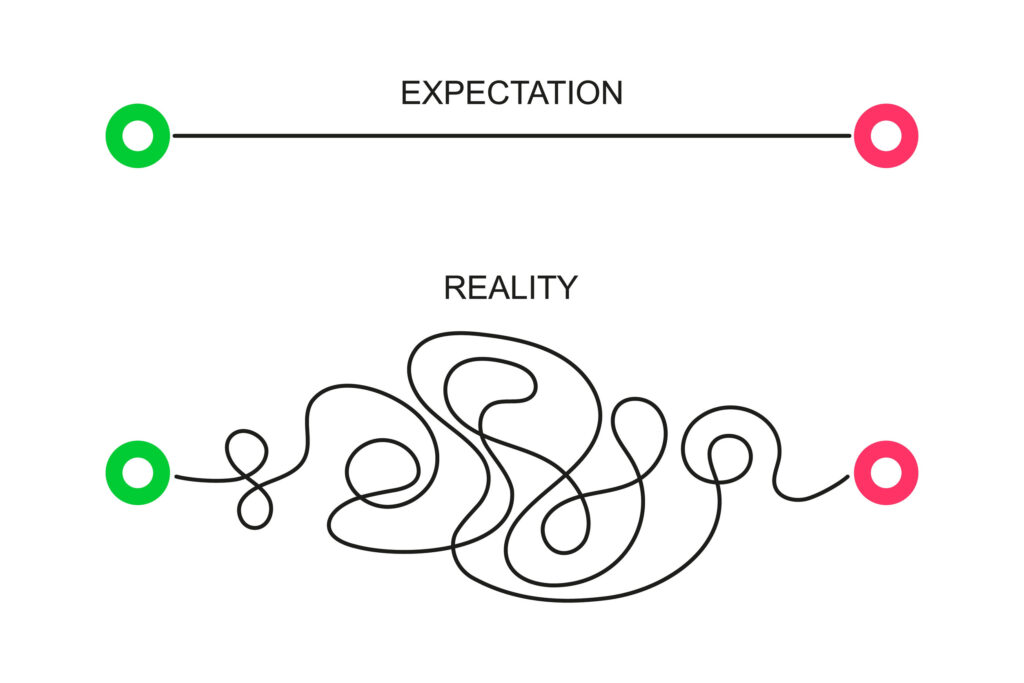
Both of those help me to cope with my unmet longing, the disappointment that I face in my relationship with you. They help me manage the discrepancy between what I want and what I get. They help me take care of me. Does that make sense? I need to manage my pain, so I either blame my silly unreasonable expectations, or I blame you and your sinful limitations.
But here’s the rub. Both of those are self-centered. Not completely off base, but fundamentally self-protective. But recently I have found myself pondering whether in fact, I do demand too much of certain people. I even hope for too much. I’m beginning to see my own heart in a couple of new ways. Let’s look at that phrase a little differently…
“I just expect too much!” Whenever I say that, I want something that I am not getting. Some desire – to be noticed, complimented, encouraged, listened to – has not been met. The thing I wonder now is “why is that particular desire so important to me?” In the past, I have found myself disappointed when visiting my adult kids and grandkids we have not found time to “really catch up.” They could have made time…but didn’t.
What I discovered was that, in the middle of their very-busy-with-kids world, “really catching up” is not as important as many other things (like the demands of their kids). But because it matters so much to me, I have to find a way to deal with that pain. And the fact of the matter is that what I expect (because it is so important to me) is too much. It makes too big a statement to me. So, the problem is, in fact, the too-high value of the expectation. I need to be looking at why that disappointment is so big in me.
Another discovery I’ve made has been the willingness to look honestly at the person who is disappointing me and ask the question, “What are they really capable of?” In my younger years, I expected everyone to have the same gifting, inclination, intelligence, and even story that I did. If they didn’t, they just needed to try harder. If their brains didn’t work the way mine did, they needed to learn or grow.
But, all of us have limitations. Sometimes I run with really smart people. I can’t think the way they do. I am not as quick. I don’t remember the way they do. They make points that I don’t fully understand (maybe not at all). They could easily be disappointed in me and even blame me because “they expected too much.” But the kind thing would be to recognize my limitations and try to have reasonable expectations for our conversations. Because of our stories, our personalities, our strengths and weaknesses, we all have limitations. That awareness should bring grace, not judgment. It should bring patience, not anger.
God, please give eyes to see that we all have limitations, and that those limitations play a part in our disappointment, and that facing that disappointment can be a gracious window into seeing you more clearly, as well as a window to see ourselves more clearly. May it lead to love.
 Palmer Trice is an ordained Presbyterian minister. He is married to Lynne, has three children and has been in Charlotte since 1979. In his spare time, Palmer enjoys golf, tennis, walking and reading.