In Luke’s account of the birth of Jesus, we’re told that the shepherds “were in the same region” as Bethlehem. They were, Luke writes, “out in the field, keeping watch over their flocks by night.” This phrase reads like poetry, because it is lyrically familiar.
But you could also read it as just plain reporting. The shepherds were shepherding, exactly where shepherds usually shepherd, and shepherding, well, sheep. So far, Luke is reporting an ordinary night. Things are as they always are.
This is so ordinary, so “as things always are,” that you wouldn’t’t expect what was coming. I don’t imagine the shepherds were expecting anything extraordinary. It wasn’t as if earlier, one of the shepherds, let’s call him Doug, said, “Hey guys, I hear there’s a heavenly host event tonight. Grab your dad’s bathrobe and let’s head over to Bethlehem.”
Probably not what Doug was thinking. They were just ordinary shepherds pulling a night shift. A visit from light-filled holy beings was not on their minds. Now, when I say they were ordinary, I don’t mean that they were unintelligent, nor that they were non-spiritual. I am assuming that, like all ordinary people, they possessed average intelligence. But I am also assuming, that like most ordinary people, they utilized their intelligence mostly to organize a task, arrange for daily comfort, or to plan out the next day. This is to say, they focused their intelligence, mostly on the ground just in front of their noses. In this regard, Doug was much like his sheep.
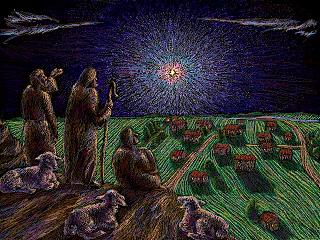
And their spirituality? Doug, like all people, contains eternal hunger. He was ordinary enough on the outside (hairy legs perhaps, good with directions maybe), you know, ordinary. But on the inside? On the inside, Doug possesses a soul, and within the soul, pulses an immense longing for unending Shalom. Doug is a spiritual being within a physical creature. Some call this an inner/outer tension: an infinity within a finitude. Yes, in a way, Doug is like his sheep, but also, no, he is not. This pulsing hunger for what is above creates a dilemma for Doug. What to do with such apparently unanswerable yearning?
What do ordinary people do? They tamp the hunger down, hold it under. We suppress the eternal yearning by compulsively focusing on the ground immediately in front of us: busyness, shopping, spats with others. We avoid looking up expectantly into the heavens. We filter out troubling hopes, so we can keep grazing. This is the tragedy of the ordinary human condition.
Now you may question my assumptions about Doug. Maybe he thought more about what is above than I’m giving him credit for. After all, David was a shepherd, and he wrote inspired poetry specifically about what was above. Like these lines, from Psalm 8:
When I look at your heavens, the work of your fingers,
the moon and the stars, which you have set in place,
what is man that you are mindful of him,
and the son of man that you care for him?
On the one hand, the night sky was for David, a glimpse of Divine architecture, of God’s greatness. And on the other hand, it provoked a stunned question: Why are people on God’s mind at all? So how can I say that the shepherds were mostly looking along the ground in front of them? My basis for saying this is built entirely on the observation that most of us are Doug and not David (even David wasn’t always David). While we all truly hunger for the transcendent—though we largely suppress it—not because it’s too small, but because it’s overwhelming.
But this night, for Doug the shepherd, the “overwhelming above” unexpectedly touches down on ordinary ground. The weight of God’s glory descends and the earth tilts under Doug’s feet, awakening his submerged hunger. Luke reports, “…an angel of the Lord appeared to them, and the glory of the Lord shone around them…” Suddenly, the shepherds weren’t shepherding anymore. Doug wasn’t keeping his eye on sheep. With sudden dreadful awareness, he realized that the Great Shepherd’s eye was over him, or rather, upon him. Not your ordinary night.
What was that like for Doug? Well, Luke tells us – he was greatly afraid, as in raw, uncanny undoing fear. This is what happens when the Transcendent becomes Immanuel. The great fear isn’t just because of as encounter with a higher being. It is sort of transformation-panic, the sensation that all that eternal hope, suppressed so deep inside of you for so long, is going to rush upward to answer the Great Shepherd’s call, and burst you irreconcilably open.
“Fear not, for behold,” the angel spoke, “I bring you good news of great joy that will be for all the people. For unto you is born this day in the city of David a Savior, who is Christ the Lord.”
There is much in those two lines. First, there is an invitation to not fear and believe that losing control of your hunger is actually good news. Second, there is the announcement that God is close. I don’t mean “close” as in a few miles to Bethlehem, but close as in God Incarnate. And third, here is the purpose of the birth. This Lord in the flesh is a Savior. This is a rescue mission. Someone who can pull you up from your stubborn focus only on the ground. A Savior who will forgive you of willful suppression of the knowledge of God within you.
But when I think of Doug, standing there in his dad’s bathrobe, mouth open, eyes upward, I am stunned by two particular words buried within the announcement. It is when the angel says, “unto you.” I picture a confused Doug, saying, “Who Me? Did you say, ‘unto you’ like unto ‘me‘?”
It slowly dawns on Doug that God, through the angel, is addressing him, hairy-legged Doug. Yes, there are other shepherds standing there. But I can’t help but think that for Doug, they all momentarily disappeared. God, the Lord, who placed the stars with His fingers, is mindful of me? And perhaps a slow astonished trust awoke that God was here, right now, to respond to a hunger that Doug had tried to forget he had.
Doug was no David. But then, neither am I. But that doesn’t matter if God wants to come unto me. Or, Unto You.
 Roger Edwards joined The Barnabas Center in 1991. He works with both individuals and couples, helping people confess their need and embrace their available choices to lead healthier lives. Roger also teaches and leads discussion groups and retreats applying the Gospel to everyday life. He is a licensed clinical mental health counselor (LCMHC), holds a master’s degree in biblical counseling from Grace Theological Seminary in Indiana and a bachelor’s degree in engineering from the University of North Carolina at Charlotte. He is married to Jean; they have seven children and nine grandchildren.